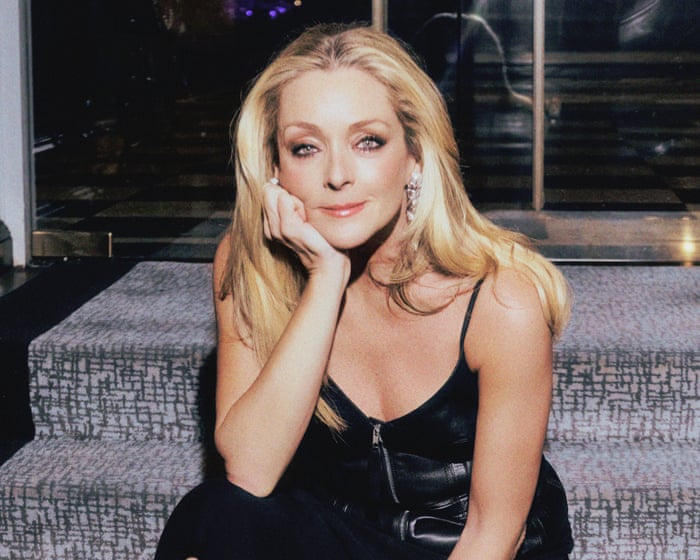
“I’ve been on three television shows that made a real impact,” says Jane Krakowski. “It sounds a bit obnoxious for me to say it, so hopefully you’ll phrase it as if you said it.” In fact, I did say it: the first was Ally McBeal, from 1997 to 2002, where she played Elaine Vassal, a quirky character in a groundbreaking series. Back in the late ’90s, people who loved debating TV and postmodernism couldn’t stop talking about the kind of feminism Ally McBeal represented—with its scattered, neurotic heroine, a fresh and unfamiliar take on the Career Woman, yet somehow more true to life. Krakowski was almost the opposite of Calista Flockhart’s title character: bold, eccentric, and unbothered by others’ opinions. Similarly, her role in 30 Rock as Jenna Maroney served as a foil to Tina Fey’s Liz Lemon—Krakowski utterly lacking self-awareness, Fey drowning in it. The show ran from 2006 to 2013, and two years later, Fey’s follow-up, Unbreakable Kimmy Schmidt, featured Krakowski as Jacqueline White, a magnetically unlikable wealthy socialite, in a world so surreal and improbable that it felt like a high-wire act only this cast could pull off.
You could debate whether Ally McBeal invented the “dramedy” or just perfected it, and discussions about Fey’s comic style could draw you in endlessly. But in each show, Krakowski creates a character you can’t imagine simply existing on the page. She’s expressive in a way that’s both high-energy and controlled, funny in a way that feels instinctive yet carefully crafted, so that the dialogue and performance explode together like two chemical elements.
None of this is particularly new. Krakowski’s unique talents have been recognized throughout her career; she’s rarely absent from nominations for Emmy, Golden Globe, and SAG awards. She’s one of those actors always mentioned during Tony season, even when she isn’t nominated (though she has been three times, winning once). She was in London last weekend for the Oliviers, nominated for Here We Are, Stephen Sondheim’s wonderfully maddening final musical, 20 years after winning an Olivier for Guys and Dolls. She didn’t win this time and knew she wouldn’t—or rather, as she told me three days before, “I don’t think the odds are in my favor, but I’m thrilled to be here.” It takes some getting used to, how consistently upbeat she is, after a career of playing exquisitely difficult characters.
Given her years on screen, it might seem presumptuous to say her true love is the stage, but it’s also a fact that Krakowski, 57, rarely goes two years without appearing in a play, most recently Oh, Mary! on Broadway. It has an “incredibly loyal and returning gay fanbase,” she says. “That experience was so joyous.”
As she tells it, she comes from a family eccentrically devoted to the stage. She grew up in New Jersey, her father a chemical engineer, her mother a college theater teacher: “We were the kind of family that would wait in the TKTS line in New York City for hours to get affordable tickets, and we’d see everything we could.” She originally wanted to be a ballet dancer, but “at a certain point, I realized I wasn’t going to be chosen for the School of American Ballet.” That world was “always striving for a version of perfection,” she says. “It was a very different time.” This was the late ’70s and early ’80s. “I think now there’s more openness about who can be in a ballet company. The worThe world has opened up and changed in a beautiful way. But back then, you needed to have a very strict body type to be accepted into a company.
Indirectly, that early discouragement shaped her performing identity. She came to realize, “There is no perfection, really. What makes people interesting is their quirks, flaws, and singularities. I became very drawn to that, and that’s what I look for and celebrate in the characters I’m lucky enough to play.”
It also left her with a discipline she is audibly proud of—that classic hoofer’s grit of never missing a show and never getting a cold. She attended the Professional Children’s School, which was founded in the early 20th century to educate kids with stage careers. “So I grew up learning with people who were in ensembles and were Broadway dancers—the athleticism is striking.”
She saw Chicago when she was eight, and the legendary Chita Rivera threw a rose straight at her as the curtain came down. That feels like a much more vivid and meaningful memory than, say, already having a film career by the age of 12, when she was cast in National Lampoon’s Vacation. “Years later [in 2003], I got to do Nine with Chita. We were both nominated for Tony awards in the same category, and on the final day, after the show closed, she said, ‘You’re like me. You grew up under the same discipline.’ I was so touched by that because basically what she said was: ‘We don’t miss shows. Unless I’m in an ambulance going to the hospital with a broken leg, there’s no reason I’m not going to be at the theatre.'”
In the 80s, Broadway was invaded by Britons—specifically, Andrew Lloyd Webber and Trevor Nunn, whom Krakowski is always careful to give his full title, calling him “Sir.” She auditioned for Les Misérables, but they went with another actor (Frances Ruffelle—”I’m so happy that happened; we became really close friends”). Lloyd Webber asked her to audition for Starlight Express. Plot-wise, this was the objectively absurd tale of the inner lives of a group of trains, performed on roller skates. “I had roller-skated at preteen birthday parties in New Jersey and had the moxie to give it a go. I got that role without really even knowing what I had signed up for. My first trip to London was to see it in the West End, to see what I’d gotten myself into.”
That was 1987—the same year Fatal Attraction came out. She had a part in the film, having auditioned on her 19th birthday. Most of it hit the cutting-room floor, but the film itself was easily the most talked-about of the decade.
Krakowski doesn’t give the impression of having chased a Hollywood career, even though she says, “I’ve loved the movie experiences I’ve had, and making films is also really hard, given the hours people put in. It might be slightly geographical, like growing up in New York and having the Broadway influence. Then with television—I don’t want to say it was my babysitter, because I had great parents who were very involved in my life—but I’ve always had such a love of theatre and such a love of television. It’s not lost on me that that’s mostly where my career went.”
Looking back, part of the originality of Ally McBeal wasn’t that it centered on an independent woman with a job, but rather that the characters weren’t played straight—Krakowski’s character least of all. She was a one-off: a mad entrepreneur, a limelight-hogger, quintessentially imperfect and unlikable. Elaine Vassal invented a face bra, a sperm-preserving Cool Cup, and an automatic toilet-seat warmer. It’s a shtick you see reprised quite often in dramedies and sitcoms now (Gina in Brooklyn Nine-Nine is a classic iteration), but it was bracingly un-It was unusual in 1997. “It became such a water-cooler show,” Krakowski says, “and I still don’t know the reasons why certain things took off and certain things didn’t,” though she notes the genius of creator David E. Kelley.
Between then and 30 Rock, she performed in London’s West End in Guys and Dolls. To be honest, I’ve never seen a bad production of it, but she was so memorable as Miss Adelaide, portraying the tribulations of the showgirl waiting for her guy to propose as both funny and achingly poignant, that she set an impossibly high standard for anyone else in the role—at least for a while.
“I really had trouble with that role,” she says. “I remember asking [director] Michael Grandage: ‘What is Adelaide really saying here? I don’t understand where she’s coming from.’ And he said: ‘She’s saying what she means.’ Every musical I had been in up to that point was written post-Sondheim. I didn’t understand, until Adelaide, how to play a role without subtext.”
Jenna Maroney from 30 Rock is arguably the character that built Krakowski’s cult following. “Tina [Fey] honed my comedic voice,” she says, “a genius writer but also such a smart producer and an incredible person.” She recalls the scripts coming off the photocopier, still warm in their hands, with no idea what was coming next—mirroring the viewer experience, as the sitcom was so anti-formulaic.
In season five, she and Fey both got pregnant within three months of each other. Krakowski says it was a “loving and supportive environment,” but viewers might remember the caustic lines about motherhood that started appearing in the scripts. At one point, Liz Lemon mistakenly assumes someone has a baby and says (I’m paraphrasing), “Sorry, it’s just that you often have food or milk or something on your clothes.”
In Unbreakable Kimmy Schmidt, Krakowski merges the charismatic narcissism she was known for with a rich-person brittleness that makes every line instantly quotable. In a way, she again serves as a counterpoint to the lead. While Kimmy Schmidt’s backstory involves being locked away from the real world, Krakowski’s Jacqueline is the one who is utterly unfit for life—so spoiled that even basic tasks like going to the pharmacy or getting water from the fridge defeat her. She brings a quality to even the most obnoxious characters—maybe not warmth, but a sense of humanness—without which it’s hard to imagine Fey’s work being what it is.
Here We Are, which ran at the National Theatre in London last year, tested that to its limits, because this musical is wild. She saw it at the Shed in New York before joining the production and remembers “just being so envious of everyone who worked on it—what a gift to get to work on Sondheim’s final puzzle.”
It’s a puzzle indeed: a family moves from one restaurant to another. They can’t get served, so they leave. “Two or three songs into act two, the music just stops.” Especially with the London cast, who were all so committed—Rory Kinnear was brilliant, as was Chumisa Dornford-May—it’s a bit baffling how so much thought and energy could go into something, yet the audience leaves none the wiser. “It is tricky!” she concedes. “It is complicated. There were times when Joe [Mantello, director of both the off-Broadway and London productions]…”He would say, “I don’t have an answer for you on this. You just have to be in the room.” You have to truly love Sondheim, I think, to forgive its flaws—which, fortunately, Krakowski does. “What always felt very emotional to me in act two,” she says, “is that you feel Sondheim leave the room. We never want Sondheim to go away.”
Krakowski once said she prefers the wrong-but-right—jokes you shouldn’t laugh at, situations that are almost too painful to watch. In person, she is the opposite: a whirlwind of gratitude and generosity toward everyone she has worked with. The tougher task of extracting gold from the swamp of human nature, she saves for the stage and screen, like the true hard worker she is.
Frequently Asked Questions
FAQs About Jane Krakowski on Ally McBeal and Her SceneStealing Career
BeginnerLevel Questions
Q Who did Jane Krakowski play on Ally McBeal
A She played Elaine Vassal the office assistant at the law firm Cage Fish Elaine was known for being blunt mancrazy and hilariously unapologetic about her wild personal life
Q What does watercooler show mean in relation to Ally McBeal
A It means the show was a huge cultural phenomenon that everyone talked about the next day at work Ally McBeal was famous for its quirky characters fantasy sequences and topics like dating and feminism which sparked constant conversation
Q What is a scenestealer in acting
A A scenestealer is an actor who even in a supporting role delivers such a memorable and captivating performance that they draw the audiences focus and steal the scene from the main characters
Q Did Jane Krakowski sing on Ally McBeal
A Yes The show frequently featured musical numbers and Jane a trained Broadway performer got to showcase her incredible singing voice in several episodes which became a fanfavorite element of her character
Advanced CareerOriented Questions
Q How did the role of Elaine Vassal differ from her later more famous role as Jenna Maroney on 30 Rock
A While both are comedic scenestealing roles Elaine was more of a naive iddriven foil to the neurotic lawyers Jenna Maroney was a supremely selfabsorbed and grandiose parody of a Broadway divaTV star Elaine was part of the ensembles chaos Jenna often was the chaos
Q What specific skills make Jane Krakowski such an effective scenestealer in comedies
A Her masterful use of physical comedy deadpan delivery of outrageous lines and her musical theater background which gives her a flawless sense of rhythm and commitment to even the most absurd bit She fully embodies her characters without a hint of winking at the audience