After Germany’s Ruhr region—the third-largest urban area in Western Europe—was heavily bombed during World War II, planners came up with a clever idea. About 80% of the area, which includes big cities like Essen and Duisburg, as well as dozens of smaller towns like Bochum and Gelsenkirchen, had been destroyed. So, during the reconstruction, a newly formed Diocese of the Ruhr built hundreds of tightly packed “Pantoffelkirchen,” or “slipper churches.” They got this name because they were built so close to housing developments that people could walk to mass in their slippers.
Today, these slipper churches are in steep decline. It’s estimated that up to 300 are now unused or abandoned, and 100 have been sold off in just the last year. Until October, 12 of them are hosting Manifesta, the traveling art biennale. These churches now stand as centerpieces of communities that have been devastated—this time not by war, but by deindustrialization, mass unemployment, and environmental decay.
Manifesta 16 Ruhr isn’t like the Venice Biennale. Think of it more as a Capital of Culture event held in the West Midlands—which the Ruhr closely resembles, as the struggling engine of national growth. Instead of exhibits in, say, Birmingham or Coventry, you’d be expected to travel to places like Bilston, Smethwick, or Stourbridge. This is much easier to do in the Ruhr, where trams are everywhere, and even tiny Bochum has a U-Bahn—though you’ll also notice these networks have been neglected since they were built in the 1970s. At first glance, the cities and towns seem greener, sleeker, and better connected than their British counterparts, but that’s a bit misleading. The A40 autobahn cuts much of the area into poorer and richer enclaves, and it’s rarely easy to walk from one to the other.
View image in fullscreen: Surreal… a basketball court where a miss triggers a blast from the church organ. Photograph: Rainer Schlautmann
Much of the Ruhr is now poorer than East Germany, after decades of deindustrialization and the dismantling of the welfare state. Gelsenkirchen has the highest vote for the far-right AfD in western Germany, and the highest unemployment rate. So Manifesta steps into very sensitive territory by taking over and trying to reimagine the social infrastructure of what can seem like a dying place, with divided communities and a struggling economy. It avoids big, flashy industrial spaces, focusing instead on tiny, abandoned churches in suburbs and housing estates. “I’ll be honest: I don’t care about churches, I care about neighborhoods,” says Catalan architect and Manifesta curator Josep Bohigas. “The churches were built for people who are no longer there.” The festival tries to use these seemingly useless—though often beautiful—structures to bridge the gap between the past and the future.
It doesn’t all work. Some of the larger empty churches contain some big, empty art—like an inflatable blue bubble with a beach inside, set up in the 19th-century neo-gothic St Josef in Gelsenkirchen. Essen’s gothic St Gertrud, which has been deconsecrated and is now used by the local School of Fine Arts, is a distant cousin of Coventry Cathedral; the surviving ruins were patched up and joined to a modern church in the 1950s. Now, their colorful expressionist-Byzantine murals face upside-down pews, turned into abstract sculptures by Nasan Tur—a not-so-subtle gesture.
The flagship is the Kulturkirche Liebfrauen in Duisburg, built in 1958 and turned into an arts center in 2011. It’s a flamboyant modernist building with the vibrant energy of Liverpool’s Catholic cathedral. Some installations here struggle to compete with the gorgeous murals and reliefs, originally made for the Vatican Pavilion at Expo 58, set between glowing walls of Plexiglas. But a fascinating two-screen film by Elizabeth Price works well as an introduction to the biennale’s ideas, mixing memories of World War II bombing with a history of those modes.Roman Catholic churches built in post-war Britain for Irish immigrants.
[View image in fullscreen]
Weimar vision … Manifesta 16 artwork inside Bochum’s Christ-König. Photograph: Ivan Erofeev
Most of these churches were architecturally bold. One, Christ-König in Bochum, is a brick explosion of Fritz Lang-style drama, built in the final year of the Weimar Republic. But ten of the churches are post-war. Hedwig Fijen, director of Manifesta Ruhr, describes them as places where architects and congregations tried “to imagine a different kind of society” after “years of war, genocide and destruction.” Yet they did so within the limits of the old world. The new churches were strongly backed by local industrial families like Thyssen and Krupp, who benefited from Nazism and preferred their workers to be devout. The arrival of “guest workers” was encouraged. Many of the miners and factory workers who rebuilt the region and fueled the “economic miracle” came from Catholic southern Europe, as well as Greece and, especially, Turkey.
Their story is told here in the “slipper churches” – sparkling architectural miniatures that have clearly inspired the most thought from curators and artists. The first one I saw, St Marien in Essen, was a sharp contrast to the tidy city-centre churches. Designed in 1963, with explosively exciting stained glass by Manfred Ott, it’s tough, red brick, and semi-ruined. It sits in a working-class, multicultural area across from a retail park where factories once stood. The church has been unused for many years, and the artworks play with a bomb-site theme, full of fragments and debris. You realize the sheer range of architectural expression in the slipper churches when you go from there to Essen’s Protestant Markuskirche, built in 1961, with its gorgeous wall of gauzy, abstract stained glass. It is also tightly connected to its community, next to a kindergarten and a care home. The main “artwork” here is a set of wooden seats and play areas by the Portuguese Pele Collective. When I visit, it feels more like a school fair than a heavy art exhibition.
[View image in fullscreen]
Postwar planning … Kulturkirche Liebfrauen in Duisburg was turned into an arts centre in 2011. Photograph: Ivan Erofeev
The most powerful and convincing projects are less cute. Both are curated by Gürsoy Doğtaş, an art historian whose parents were Turkish “guest workers.” His team renamed two churches in Gelsenkirchen: St Bonifatius became the Ferdane Satır Tea Garden, named after one of seven Turkish guest workers murdered by fascists in an arson attack in Duisburg in 1984; and Thomaskirche was renamed after Hava Güleç, a local factory worker seen as a pillar of the community. St Bonifatius (1963) is in the hard, red brick expressionist tradition and stands in a densely urban area along a main road. It has effectively become an art museum of the guest worker experience.
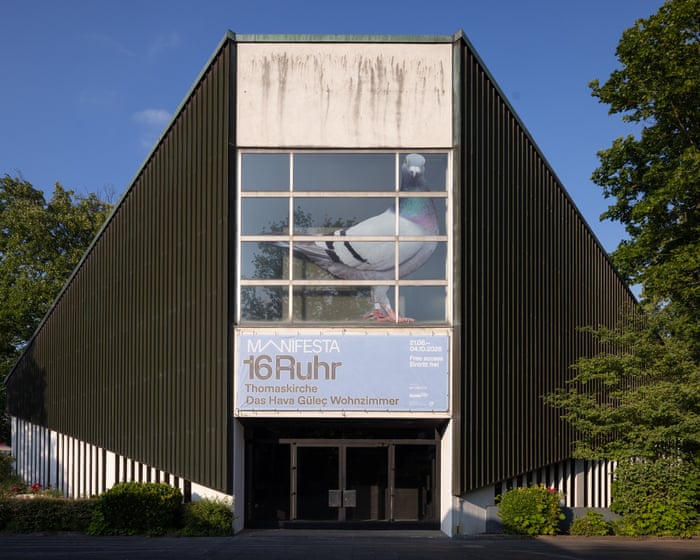
At Thomaskirche, the crystalline space is overlooked by “Friend,” a massive printed pigeon by artist Gülbin Ünlü. It includes Judith Raum’s film about the German-engineered Baghdad Railway, which serves as a kind of prehistory: German industrialists make approving comments about docile Ottoman workers who don’t strike and don’t ask for pay raises. Below, photographs document Turkish guest workers’ struggles and strikes in Germany 70 years later. Thomaskirche is mostly dedicated to textiles and feminized factory labor in an area of old mills – there are public weaving workshops in the church hall. Impressively, the Gelsenkirchen churches are full of art by workers, rather than work about them. Many began as guest workers – like Abuzer Güle, whose expressionist Anatolian scenes are hung on industrial frames in Thomaskirche, or Hanefi Yeter, whose “When the Earth Burns,” a Diego Rivera-like apocalyptic Ruhr allegory from 1984, hangs in St Bonifatius.
[View image in fullscreen]
‘Gorgeous gauzy abstract stained glass’ … more Manifesta artwork inside Markuskirche in Essen.A photograph by Silviu Guiman captures the scene. But the Ruhr’s first boom, in the late 19th and early 20th centuries, was largely powered by Polish labor. In Bochum’s disused Gethsemane church—one of several “emergency churches” designed by Weimar modernist Otto Bartning, built literally from rubble by the local community in 1947—Polish curator Krzysztof Kosciuczuk brings together more ironic, playful works about migration. Outside the church, in a quiet area of modest houses and gardens, there’s a bouncy castle shaped like a church bell. Created by Belarusian artist Marina Naprushkina, it first looks like a silly, friendly gesture—until you read the bold lettering: “We’ll Never Go Back!”
All of this is, of course, temporary. One work, in a 1960s slipper church—Bochum’s small, angular St Ludgerus—has been turned into a basketball court. This isn’t new: in Gelsenkirchen, St Josef had one for a while. But what this one, designed by Catalan artists Cabosanroque, does is encourage clumsiness. If you miss the net, a loud blast from the church organ goes off. You can sit in the “stands” made of church pews and watch a strange scene unfold, as local youth and biennale visitors, lit by stained glass, try to miss their shots. It’s interesting precisely because of its unique surrealism and oddness.
These micro-modernist slipper churches were built on a shared understanding: their bold modernism was rooted in beliefs that their working-class congregations all held. Without that kind of unity, this mix of protest, whimsy, and spatial experimentation suggests that diversity might still create spaces just as extraordinary—if given the money and time, both of which are usually scarce in places like the Ruhr. Manifesta 16 Ruhr runs until October 4.
Frequently Asked Questions
Here is a list of FAQs about the topic A Ruhr treat can a giant pigeon and a pink basketball breathe new life into Germanys struggling industrial heartland
BeginnerLevel Questions
1 What is this giant pigeon and pink basketball thing
Its a nickname for a huge colorful art installation in the Ruhr region of Germany The giant pigeon is a massive sculpture of a bird and the pink basketball is a giant bright pink ball They are part of a project to attract visitors to old industrial sites
2 Why are they putting art in an old industrial area
The Ruhr region used to be full of coal mines and steel factories When those closed the area lost jobs and people The idea is to use art like these big sculptures to turn old factories and mines into tourist attractions bringing in new money and attention
3 Is this just about two weird statues
No The pigeon and basketball are just the most eyecatching examples The real goal is a larger plan to use art culture and creative businesses to transform the regions economy and image
4 Who paid for this
The projects are usually funded by a mix of government grants cultural foundations and sometimes private sponsors
5 Has this worked before in other places
Yes the most famous example is the Guggenheim Museum in Bilbao Spain A stunning building turned a struggling industrial city into a major tourist destination The Ruhr region is trying a similar more spreadout version of this idea
AdvancedLevel Questions
6 What are the main problems with using art to revive an old industrial region
A big risk is gentrification Art can make an area trendy driving up rent and pushing out the original workingclass residents Another problem is that it can create temporary popup culture that doesnt lead to stable longterm jobs for locals It can also feel fake or imposed from the outside
7 How does this Ruhr treat project differ from the Bilbao effect
Bilbao was a single iconic building The Ruhr region is using a network of many sites called the Route of Industrial Heritage Its a more decentralized approach spreading visitors across a whole region instead