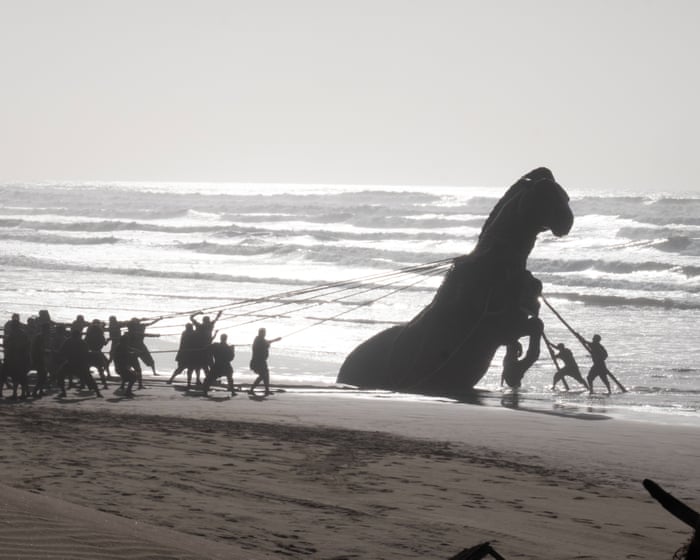
Adapting a 12,000-line poem that takes a full day to recite into a three-hour film was always going to require some cutting. That’s exactly what happened with Christopher Nolan’s The Odyssey, which leaves out several scenes and characters from Homer’s ancient Greek epic. Nolan also shifts the focus in some of the story’s most famous moments and adds a few of his own. Here’s a rundown of the biggest changes.
What Nolan left out
The gods
Homer’s Odyssey begins with a conversation between Zeus and Athena on Mount Olympus. With Zeus’s approval, Athena actively guides Odysseus home, helps him defeat the suitors, and encourages his son Telemachus, all while using various disguises. Meanwhile, Poseidon blocks Odysseus’s path, and Hermes is sent on a couple of key missions. The only god Nolan includes is Athena (Zendaya), who appears as a vision only Odysseus (Matt Damon) can see. She seems to represent his conscience rather than being a full-fledged divine figure.
Nausicaa and the Phaeacians
One of the Odyssey’s most famous scenes is Odysseus meeting the young princess Nausicaa. He washes up naked on a strange island where she and her maids are playing with a ball. After they handle the awkward situation gracefully, Odysseus follows Nausicaa to the city of the Phaeacians. There, he tells his stories of the Cyclops, Circe, Scylla, and Charybdis before being given safe passage back to Ithaca. Nolan cuts the Phaeacians entirely and has Odysseus tell those stories to Calypso (Charlize Theron) as recovered memories.
Some major ghosts
The film shows Odysseus meeting his former commander Agamemnon (Benny Safdie) in the land of the dead (Nolan is right not to portray it as an underworld). But we don’t see Achilles, the greatest Greek warrior, or Ajax, who in the poem silently rejects Odysseus’s attempt at reconciliation. We also don’t meet Odysseus’s mother, whom he tries and fails to embrace three times. Another missing character is the unlucky Elpenor, who falls to his death after drinking too much and then begs for a proper burial. It’s easy to see why Nolan wanted to cut these spiritual encounters, even though they’re powerful and meaningful in the poem.
The execution of the disloyal women
Unsurprisingly, Nolan avoids including the Odyssey’s nastiest scene, where 12 enslaved women who were disloyal to the household and slept with the suitors are hanged by Telemachus. But Nolan adds a similar detail: he shows one of those treacherous women, Melantho (Mia Goth), effectively condemned to death by Odysseus’s wife, Penelope (Anne Hathaway), who pushes her into the chaos while the suitors are being killed. He spares us the gruesome fate of the odious goatherd Melanthius, who in the poem has his nose, ears, hands, feet, and genitals cut off.
Penelope’s bed test
Homer’s Penelope is no pushover when Odysseus returns. To make sure the beggar who just killed the suitors is really her husband, she gets him to describe their marriage bed, which only he and Penelope know was made from an olive tree. Nolan leaves out this detail, which shows Penelope is just as clever as her husband. Instead, Odysseus shows her a figurine of Athena to prove who he is.
What Nolan added
The wooden horse
Homer doesn’t tell the full story of the wooden horse, but it’s mentioned three times in the Odyssey (and not at all in the Iliad). Since using the horse to break into Troy was Odysseus’s idea and key to the Trojan story, it seems fittingI hesitated to include it in the film.
Sinon
The character Sinon (Elliot Page) is shown tricking the Trojans into accepting the wooden horse, but he doesn’t appear anywhere in Homer. Nolan is drawing from Virgil’s account of the fall of Troy in the second book of the Aeneid. He also creates a backstory where Sinon is forced to take the place of Antinous (Robert Pattinson) in the Greek army at Troy.
The people from the sea
The film often mentions that the world of the Greek heroes is threatened by “people from the sea.” This isn’t a concern in Homer’s Odyssey. And no Homeric character says, as Nolan’s Odysseus does, that the Trojan War was really about “trading routes.” But these nods to ancient historians show Nolan has done his research.
What Nolan has changed
Calypso
Nolan’s Calypso drugs Odysseus with lotus flowers to make him lose his memories, but then feels pity for him and lets him go. In the poem, Calypso doesn’t use drugs—she’s very focused on sex (which we don’t see in the film). She forces Odysseus to share her bed night after night, even though he’s desperate to go home. She only releases him after Hermes tells her that Zeus has ordered it. As a mere nymph, she knows she must obey Olympus. Once it’s clear he can leave, Odysseus enjoys one last night with her before sailing off on his raft.
The Cyclops
Nolan’s Cyclops barely speaks, while in the poem he has a deadly, comic banter with Odysseus. The lack of dialogue in the film makes the one-eyed giant scarier, but we lose two important details from the poem: the trick where Odysseus calls himself “Nobody” so the other Cyclopes won’t help the blinded monster, and the moment when Odysseus recklessly reveals his real name, allowing the Cyclops to ask his father Poseidon to curse Odysseus’s journey home. These changes fit Nolan’s choice to downplay Odysseus’s trickster skills and focus on his battle-hardened resilience and trauma.
Circe
It’s never explained why Homer’s Circe turns some of Odysseus’s men into pigs. She turns them back because Odysseus is immune to her potion (thanks to a herb from Hermes) and then agrees to sleep with her. She becomes a helpful ally, and he stays with her for a whole year. Nolan’s Circe (Samantha Morton) seems angry at animalistic male behavior, but then meekly agrees to restore the men after Odysseus figures out he shouldn’t touch the stew and makes her feel sorry for a group of guys who just want to go home.
The ambush and father-son reunion
In the film, villains hired by Antinous try to kill Telemachus (Tom Holland) at a temple, but Odysseus, in disguise, stops them. Soon after, Telemachus realizes his savior is his father. In the poem, the ambush is led by Antinous at sea and is easily avoided by Telemachus. He then meets his father back in Ithaca in a reunion carefully arranged by Athena.
The ending
Homer’s Odyssey has a famously unsatisfying ending. Nolan wisely drops all the final scenes: the suitors arriving in the underworld, Odysseus meeting his father Laertes (whom he unnecessarily upsets by using another fake identity), and the anticlimactic battle between Odysseus and the suitors’ relatives. In the film, Telemachus becomes king of Ithaca, allowing Odysseus and Penelope to sail off into the sunset on a mission to honor his fallen comrades.
Chris Tryhorn is the author of Homer’s Odyssey, a new version.The original story is now available as an ebook.
Frequently Asked Questions
Here is a list of FAQs about the themes of sex beds and brutal executions in Christopher Nolans films written in a natural tone with clear answers
BeginnerLevel Questions
Q Why does sex show up in Christopher Nolan movies It never feels romantic
A Nolan rarely shows sex for passion He uses it as a tool to show power dynamics manipulation or deep psychological pressure Think of the seduction in Inception or the coldness in The Prestige
Q Whats the deal with beds in Nolans films They seem important
A Beds are often a liminal space for Nolan They represent the threshold between reality and dreams or between life and death Theyre where characters are most vulnerable
Q Are the executions in Nolans movies really brutal
A Not in a gory slasherfilm way Nolans brutality is psychological and clinical The hanging in The Dark Knight Rises or the drowning in The Prestige are brutal because of the cold methodical way they happen
Q Is the sex in Nolans movies just for shock value
A No Its usually tied to a plot twist or a characters hidden motive For example the sex scene in Inception is actually a memory that reveals emotional damage not just a love scene
Q Whats the most famous bed scene in a Nolan movie
A The opening of Inception and the hotel hallway fight in zero gravity The bed is literally the anchor for the dream machine
AdvancedLevel Questions
Q Why does Nolan connect sex with betrayal so often
A He often views intimacy as a weakness or a trap In Memento sex is a tool for revenge In The Prestige it leads to a fatal rivalry For Nolan sex is rarely a source of happiness its usually a cause of conflict
Q Is the bed a symbol of death in Nolans work