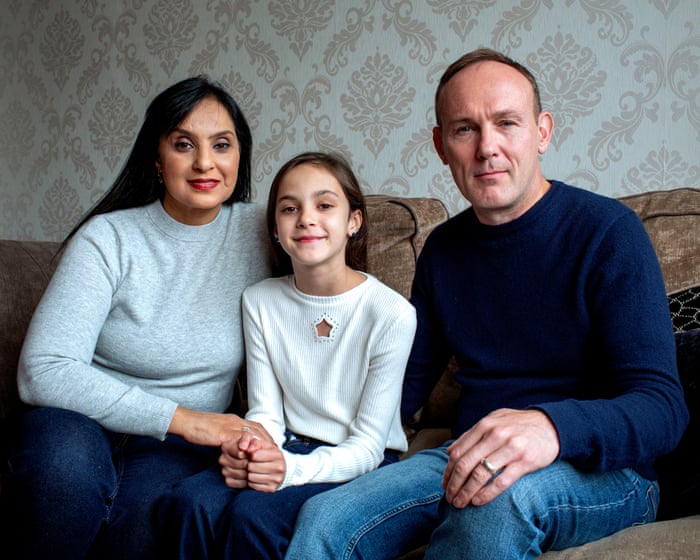
“I’m afraid this cycle hasn’t worked.” Emma and I can’t meet each other’s eyes. We sit in silence in the IVF doctor’s office, consumed by grief. This is a kind of grief that often isn’t even recognized as grief. It’s grief over the loss of a potential child—an anticipatory grief, a mourning for something that hasn’t appeared yet, for a possibility, for a longed-for future life to welcome, love, and nurture. There are no established rituals for this kind of grief—for a child who was never born—no place in our society to mark it, to mourn a loss that isn’t a physical death. It is a silent, achingly lonely, isolated grief. We had tried many times in the years after our daughter Gaia was born. But that didn’t make it any easier.
Each cycle, each time we sat in that office, we had to push aside our grief and focus wholeheartedly and positively on the next attempt. We didn’t get any help during this time. We didn’t seek counseling as a couple. I had no idea how to process my grief—which grew heavier month after month. More cycles, more drugs, more fertility hormones, more ovarian hyperstimulation, injections, scans, blood tests—all of them unsuccessful. I supported everything wholeheartedly, but Emma was devastated by her inability to conceive again. In her mind, she had failed, and she couldn’t forgive herself for that failure. Nothing I could say would change her mind.
Her deep grief pulled her away from me. I had to deny my own. I tried to comfort her rather than myself. Such is the lot of the self-appointed savior.
Emma and I had met seven years earlier on the set of the film Sense and Sensibility. She had adapted Jane Austen’s novel and was playing Elinor Dashwood; I was John Willoughby, a “caped Adonis” on an enormous white horse, galloping in to scoop up her injured sister Marianne and carry her home. As I leave the scene—the hero of the hour, the savior of a potential catastrophe—in a swirl of cape and the heady musk of testosterone: “His manly beauty and more than common gracefulness were instantly the theme of general admiration.” The problem was, that’s how I had always seen myself in real life.
Emma and I came together in the unreal space of a film set. Film sets are very seductive places. They’re protected spaces, where we’re all outside our normal, everyday lives. And it was here that my role as savior in the film and as savior in life collided.
I galloped in on my big white horse, scooped her up, and saved her.
View image in fullscreenThe couple in 2001. Photograph: Evan Agostini/Getty ImagesEmma’s husband had moved out of their home just before filming started. She was in deep grief over the apparent end of her marriage. But she also carried a chronic grief. Her father, Eric Thompson—the writer and narrator of the cult TV show The Magic Roundabout—had suffered his first heart attack when Emma was eight. He had a severe stroke 10 years later that left him semi-paralyzed, and she took it upon herself to help this extraordinarily skilled lover of language speak again. He died when she was 23.
She had already lost her wonderful uncle—her mother Phyllida’s brother James. He had been in a catastrophic car crash early in life and never fully recovered. He suffered a brain hemorrhage when Emma was in her late teens. She was the only family member present to make the decision to turn off his life support, and then she walked home alone with a trash bag full of his clothes. Within a few short years of her father’s death, she also lost the other vital male figure in her life, her godfather.
When filming finished, we hid ourselves away in my little two-up, two-down house in north London. Both of us brought along our overstuffed suitcase of grief, bulging with recent and age-old unresolved pain.
After three years together, it was time to settle down. It was, we decided, time to startThis was the first shape that was created: a family. We bonded in our grief—Emma’s present grief at the end of her marriage, my anticipatory grief that she might still try to revive it, and grief at the possibility that this relationship might die so soon, with so much recent love and so much future promise.
Then everything exploded when the tabloid press found us out, and we had to escape. We created a new shape—the fugitives.
We went to work in Los Angeles, rented a house there, filmed projects, and lived a fun life up in the hills, with a pool and a convertible sports car. Our shape now was that of a hopeful, creative, unfettered, adventurous, outward-looking, energized couple. But this shape could not last. We had to reshape ourselves to the realities of our lives. With Emma now divorced, we decided it was time to come back home. After three years together, it was time to settle. It was, we decided, time to start a family.
Then the next grief hit us.
We were unable to conceive, and Emma was fast approaching 40.
The simple fact that we could not get pregnant was momentous. It is one of those major marking points, the end of one way of looking at life. In a way, it is a death—the death of a possibility, the death of a new shape that had been expected—and it brought both profound grief and a deep sense of shame in its wake. Both Emma and I felt that shame, because we saw ourselves as unable to fulfill our purest and most natural role in life: to procreate. We hit an existential crisis. It is a given in all the stories we read as children, telling us that girls grow up to become mothers and boys to become fathers. Emma was therefore not a proper woman, and I was not a proper man.
Even without knowing the root of our problem, I was gnawed at by a sense of being emasculated. I was confused by the way my fertility seemed tied to my manliness, virility, and sexual potency. I could not shake the feeling that I had somehow failed as a man, with the simple idea spinning in my head: infertility equals impotence.
We both took tests to see where the problem lay. The problem lay with Emma. We would never be able to conceive naturally. IVF was the only option if we wanted to have a child of our own.
We did not know that IVF opens up a potential minefield of grief—a constant swinging between hope and despair within each cycle of treatment. It is absolutely extraordinary that IVF treatment exists. Extraordinary, but also brutal. And oddly, within a process that hopefully results in the creation of a human, it can feel utterly dehumanizing. It is purely a clinical process, and it is easy to become totally overwhelmed by every aspect: decision-making, appointments, injection schedules, scans, where to get the treatment, how many embryos to transfer.
We knew we were so fortunate to be able to afford the process, but we did not know that embarking on IVF opens up a potential minefield of grief—a constant swinging between hope and despair within each cycle of treatment. It was physically grueling for Emma. She was exhausted, in pain, filled with chemicals, her hormones all over the place, overstimulated while at the same time having to try to remain resolutely calm.
And all I could do was support her. Within this treatment, my capacity for any sense of agency was almost nonexistent. My job, in its clinical entirety, was purely to provide some sperm. That was it. I just had to do a quick sprint; she was on the marathon.
And I could not fix this. I could not make things better or make this work. This was so hard for me to confront—I could not be the savior now. I just had to try to be strong, protecting Emma as best I could, trying to lighten the load as much as I could. But this was her gig, not mine.
Our very first attempt at IVF resulted in a positive pregnancy test just days before her 40th birthday. Four weeks before we welcomed in the new millennium, we celebrated the arrival of our beautiful, healthy baby daughter.Gaia, whom we had first seen at four cells old. Our shape had changed once more: we were now awestruck, doting parents. View image in fullscreen Thompson and Wise, with their newborn daughter, Gaia, in 1999. Photograph: PA Images/Alamy. In Gaia’s second year of life, we started another IVF cycle. And failed. Repeatedly. That day in the doctor’s office, we decided to stop. The most difficult decision we had yet had to make. No result, nothing tangible, it just stopped. It had failed. Rationally, it was the only decision we could have come to – emotionally, it was untenable. We were dislocated, isolated in our overwhelming grief. I now know we were slipping into complicated grief. Even though there can be no set timescale for processing, the myriad of feelings within the grief can expand themselves into our void of loss and become a chronic problem. This grief can consume our lives. The precision of the grief, the focus of the loss, muddies and seeps out and, over time, if not addressed, metamorphoses into major depression. This is where it took us, an overbearing blanket of sadness covering the two of us. And we both felt so alone; we couldn’t address it as a couple, we didn’t seek help together. This complicated grief, given the medical moniker prolonged grief disorder, now classed as an official mental health disorder, hits about one in 10 of us powerless to come to terms with our loss half a year on. A helplessness, inability to accept, disbelief, numbness. Grief is natural, grief is healthy, grief is essential in the process of being able to adjust to where we find ourself after a loss, but it can become a clinical problem, it can disrupt our life so fully that we can’t find a way out. And it can be made even more toxic if guilt and shame are in the mix. I had never been a more grief-sodden mess, feeling myself, months after we had finally made the decision, falling into a black depression. I had totally hit the bottom and could not navigate myself out of the darkness I found myself in. There was nothing I could do. Other than to ask for help. I have always been a bit of a northern man about getting medical help. I am terrifically accident-prone. From a childhood spent falling out of trees to being a grownup with a collection of madly dangerous power tools, I have often wandered back to the house with blood streaming, large bone-showing holes, but refusing to seek out a medical professional. I have a certain amount of shame attached to my self-inflicted injuries; that the medics would view me as they would a child with a saucepan wedged on their head – humorous, a bit pathetic, but mainly just idiotic. “I knew I was in pain. I knew that I needed professional help.” I viewed therapy in the same way. A neurotic American fixation, an ego-fuelled unnecessary waste of time and money, and something to be sneered at. Our lot in life was to deny, obfuscate and just bloody well get on with it. This was my belief. Skip past newsletter promotion. Free newsletter | Weekly. Sign up to Inside Saturday. The only way to get a look behind the scenes of the Saturday magazine. Sign up to get the inside story from our top writers as well as all the must-read articles and columns, delivered to your inbox every weekend. Enter your email. Sign up. After newsletter promotion. Then I moved in with Emma. She had started her therapy before we got together, and would wander off down the street to see her Jungian therapist weekly. After a while, I started to perceive this as a threat. I’d heard stories of a partner getting therapy and then breaking up the relationship – that it involved laying the blame for the couple’s ills on the other partner. The fact that I thought this illustrates the fear and pain that were my constant companions. I was told many years later that you finally go into therapy when you realise that the pain you are carrying is greater than the pain of exploring it. And therapy is painful, without doubt. It is painful because you are exposing things that have been living in the veryThe core of your being for perhaps your entire lifetime, and often these things don’t give themselves up without a fight. But I knew I was in pain. I knew that I needed professional help. Starting it was the best decision I have ever made.
I began my journey in a little upstairs room in central London. The first thing that confused me was that I wasn’t lying down – the pose adopted in all the films I’d watched. The second thing was that, six sessions in, the only one seeming to be doing any talking was me. I couldn’t see any therapy happening whatsoever. It was gently pointed out to me that nothing could be discussed until my story had unfolded enough to be looked at.
I brought shame with me into the room. It wrapped around me, muffled me. Shame brings muteness. I needed to articulate what had up till now never been articulated. That was one of the most difficult aspects of this, telling my history, as honestly and personally as possible.
But a large part of my shame was that I didn’t seem to be doing this properly. I would start to try to unpack with, “I think …” and be told, “I would really like to know what you feel …”
I didn’t know what I felt. Apart from feeling I wanted to stop coming to therapy. That I was being made to feel ashamed by the process.
Even though everyone’s grief is unique to them, there are clear patterns to where it sits, whether in feeling or thought. I approached my grief in a cerebral way, as I had been brought up to do: think my way through.
I was grieving the way the majority of men grieve. I had my dad as my original guide to what being a man looked like; I had my single-sex school, bringing along with it how boys should behave and what kinds of men they should become; I ventured out into my adult life as Man the Saviour – the protector, the provider of safety and security, setting aside my wants for the sake of the other, emotionally restrained, self-controlled.
This is what I brought into the therapy. What it is to be a man – independent, not showing vulnerability, strong, stoic. All these traits, given to me to wear like an ill-fitting jacket, made this type of therapy almost impossible for me. I was thoughtful, active, a problem-solver, but I was being asked to be open, expressive, available emotionally.
It took me a while to see that this type of therapy was not for me. That this style required an expression of feeling. That here, grief meant emotion. That my being different from the model that was being expounded meant I was failing. I had to go and see what else was on offer.
And there is an almost limitless amount of therapy available – animal-assisted, humanistic, psychosynthesis, existential, Jungian, Freudian, gestalt … The psychoanalytic side – about the unconscious, dream analysis, free association – all emotion-driven. But alongside this is an action-oriented approach – behavioural therapy – identifying patterns, working out solutions, using a pen and paper. Being cognitive. This was the one for me.
There are two main strands of cognitive therapy – analytic (CAT) and behavioural (CBT). The analytic looks at our past to try to understand our present-day thoughts and actions. Questionnaires are filled out, problem patterns are written down, ways of navigating found. The behavioural focuses on our present-day problems, helps change the way that life is looked on, replacing negative thoughts, encouraging a more positive outlook.
I found myself working with a CAT therapist. I felt, for the first time within a therapeutic setting, that I was using my natural strengths – I had always needed to draw a problem on paper: create a diagram, a flow chart, a design. This was the way my mind worked; that’s what led me to study architecture. Here, I was doing the same thing – seeing myself from different angles, where the constructional stresses lay and how the shape of my present form was dictated by the lay
Frequently Asked Questions
FAQs Greg Wise Emma Thompson on Failed IVF
1 What happened with Greg Wise and Emma Thompsons IVF treatment
They went through IVF that didnt work In a joint interview Wise said the failure left them in an existential crisis
2 What does existential crisis mean here
It means a deep loss of identity and purpose Wise said Thompson felt she wasnt a proper woman and he felt I wasnt a proper man because they couldnt conceive
3 Why did they feel that way
Both linked their selfworth to being able to have a child When IVF failed those feelings of inadequacy hit hard for each of them
4 Did they have children in the end
Yes Their daughter Gaia was born in 1999 Wise has said she was conceived without IVF
5 How did they cope with the failed IVF
They talked openly about it leaned on each other and eventually moved forward Wise has described the experience honestly rather than hiding it
6 What is IVF in simple terms
In vitro fertilization eggs are collected and fertilized with sperm in a lab then an embryo is placed in the womb Its a common fertility treatment but it doesnt always succeed
7 How common is IVF failure
Quite common Success rates vary by age and clinic but many cycles dont result in a pregnancy and it often takes more than one attempt
8 What emotional problems can follow failed IVF
Grief shame anxiety depression relationship strain and feelings of inadequacymuch like what Wise and Thompson described
9 What practical tips help couples after failed IVF
Talk openly with each other seek counselling take a break before deciding on next steps and avoid blaming yourselvesinfertility isnt a personal failure
10 Whats the takeaway from their story
That infertility can shake identity and selfworth for both partners and that speaking honestly about it helpsand that a family can still come together in other ways