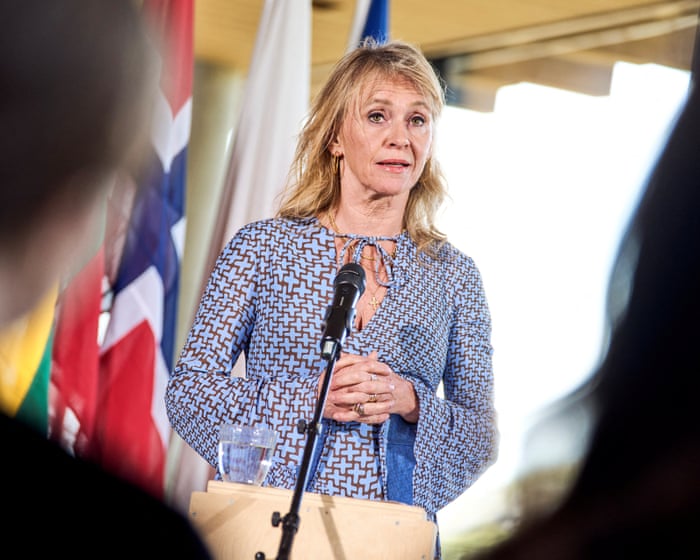
Cynthia Erivo is thinking about her favorite crisps—the ridged American brand Ruffles—as we sit talking in a quiet corner of a west London restaurant. Dressed all in black and sporting her signature long nails, she’s known for her healthy lifestyle, but everyone, it seems, has their vices. “Ruffles are just perfect,” she says. “When you get a good batch, and the salt-to-potato ratio is perfect… it’s amazing.”
Erivo has just landed after singing in Phoenix, Arizona, the night before, and has been walking me through the health routine that helps her keep up her frantic schedule. Before her concert, there was the Dior front row at Paris fashion week, and she’s just been announced as a guest host on SNL UK. Erivo doesn’t drink alcohol (today she orders peppermint tea); she’s vegan; she doesn’t eat airline food, only her own prepacked meals. She even has an infrared sauna “to help me heal from the inside.” Earlier this year she ran the London Marathon before jumping on stage to perform Dracula, where she played all 23 parts; she had rehearsed her lines while doing grueling marathon training runs. All that requires discipline—and snacks—to keep the show on the road.
She has flown in this morning to promote her new film, the legal drama Prima Facie, an adaptation of Suzie Miller’s one-woman play about sexual assault, in which Jodie Comer wowed audiences in 2022. Erivo bristles when I ask if she was hesitant about taking on a role so associated with someone else. “I get asked that question a lot,” she says. The pair actually met at a fashion dinner and spoke about the role—”Not asking any tips or anything”—and Erivo insists she was always going to make Tessa her own. “I’m never worried about what someone else has done,” she says. “I try to be respectful.”
Erivo plays a rising-star barrister, well versed in defending men accused of sexual assault. Tessa knows how to dance around the courtroom—and the victim—raising inconsistencies that make convicting a man “beyond reasonable doubt” almost impossible. When Tessa is raped by a colleague, her world implodes, and it becomes clear just how brutal the British justice system can be for women, who, according to Rape Crisis, have a one in four chance of being sexually assaulted, while only 2.7% of reported rapes result in charges being brought.
“I think we’re very wishy-washy when it comes to what consent is, when we shouldn’t be.”
Miller, a former barrister herself, said the inspiration for the story came from her realization that “it’s almost impossible to actually run a sexual assault case and win it.” Tessa, says Erivo, doesn’t see how hard it is for anyone to recall traumatic events in detail, or how lopsided the system is, until it’s swallowing her whole. “I don’t think she realizes that until she’s on the other side. I think it’s only then she realizes what she’s been asking other people to do—when it comes to recall—is actually impossible.”
Is Erivo hopeful the film can have a lasting impact? “We have had judges see it, we’ve had lawyers see it, [but] one of the major issues is the way we view consent,” says Erivo. “I hope that as this film filters out, we start to have a conversation not just among us as people, but within law.”
The film’s central struggle is twofold: the legal system victims have to navigate, and the bigger question of consent, which Erivo thinks is often far simpler than it seems. “I think we’re very wishy-washy when it comes to what consent is, when we shouldn’t be,” she says, leaning forward. “It’s very clear what consent is: if a person isn’t conscIf someone is unconscious or not conscious enough to say yes, they’re not saying yes. If a person doesn’t say yes, they don’t say yes. If their body language doesn’t say yes, they don’t say yes.”
Tessa’s rise through the legal ranks as a working-class Black woman mirrors Erivo’s own ascent through the West End, Broadway and Hollywood. After arriving at the Royal Academy of Dramatic Art (Rada), Erivo had to navigate a strange world deeply rooted in tradition and privilege—one she hadn’t been exposed to growing up in south London. When I ask Erivo what it was like navigating that space, she gives a one-word answer: “Hard.” She held down three jobs, including working every imaginable role at the Stratford East theatre, while classmates with money simply had to turn up. “I was exhausted all the time,” she says. “We’re in class, and it’s a Monday; I’ve worked all day on a Sunday, probably done a gig at night, and I’ve come in. I’m falling asleep in class, so people were like: ‘She doesn’t care.’”
On stage as Celie in The Color Purple at Menier Chocolate Factory, London, in 2013. Photograph: Tristram Kenton/The Guardian
Erivo tells me how she had to turn down a backing singer gig with Westlife that would have lasted two weeks and paid her £10,000—enough for a couple of years’ tuition. “When I went to the registrar to say, ‘Hey, can I take these two weeks to go and do this? It will pay for my fees,’ they said, ‘No, you can’t. If you go, you leave. If you stay, you stay.’” Erivo says the incident showed how at Rada there could often be “a deep misunderstanding of what it is like to need money,” something she is trying to address in the role she has held since 2024 as vice-president of the institution.
“I want it to be different,” she says. “Rada is not an easy place to go to school. It asks a lot of you. If you’re a kid who is really talented but you’ve never picked up a Shakespeare before, you now have to learn a new language. If you’ve never read a Greek play before, now you have to understand what anything means with the Greeks. That’s a big shift from doing plays at school.”
James Norton was in Erivo’s year at Rada and recently recalled how she would occasionally burst into song, something she had been doing since her school days in Clapham, where she’d perform Brandy and Monica’s The Boy Is Mine in the playground. “The room would go completely silent,” said Norton—no surprise, because despite Erivo being little over 5ft tall, she possesses a gigantic voice. It’s a tool capable of the grandstanding volume needed for musical theatre, but also the subtler demands of R&B. In her forthcoming memoir, Erivo recalls being asked at Rada to sing the parts of a white student who was ill, but rather than being replaced, the student was allowed to mime along. “The powers that be took my voice away and gave it to someone else,” is how she described it. In 2020 Rada apologised for institutional racism, later publishing an anti-racism action plan and appointing David Harewood president alongside Erivo.
In Steve McQueen’s film adaptation of Widows (2018). Photograph: Collection Christophel/Alamy
Erivo set about reclaiming that voice in her post-Rada career, at first mostly on the stage, including a star-making Broadway turn in 2015 as Celie in The Color Purple. The New Yorker’s Hilton Als went to see the production not expecting much (he’d been disappointed by the film adaptation) but remembers Erivo’s Celie as a revelation. “It was like listening to Judy Garland when she first started out,” he told me. “She keeps you marvelling at what is surely a God-given talent.” Erivo says that show was pivotal for her. “The Color Purple was one of those moments where I went from a jobbing actress and just pleased to“Being there for someone who was known for that particular piece. My life looked different after that.”
Before Broadway, she had brief TV roles in Michaela Coel’s Chewing Gum and Mr Selfridge, but things changed again in 2018 when Erivo starred in Steve McQueen’s adaptation of Lynda La Plante’s all-female heist story Widows. Hollywood took notice, and she was cast as two African-American icons: soul star Aretha Franklin and abolitionist Harriet Tubman. But playing Tubman sparked a backlash. Some argued that because she is British-Nigerian, the casting was “disrespectful to African Americans” and part of a wider trend of Black British actors—including Daniel Kaluuya (who played Fred Hampton in Judas and the Black Messiah) and David Oyelowo (who played Dr Martin Luther King in Selma)—taking roles that some felt should be reserved for Black Americans.
View image in fullscreenWith Ariana Grande at the Screen Actors Guild awards in LA, in 2025. Photograph: Jay L Clendenin/Rex/Shutterstock for SAG
The criticism hurt Erivo, and at the time she told the Guardian: “Before I’m British, I’m a Black woman. The first things people see are the colour of my skin and my sex.” I’m interested in her thoughts now, almost a decade later. “I still think it’s happening,” she says, answering almost before I can get the question out. “And I think it’s a waste of everyone’s time.
“I think we could all just sit in a room and be like: ‘OK, so what’s the problem? What’s going on? How do we fix this? How do we stop doing this?’ Because nobody else does this. Nobody else is having this conversation. The Australians and the Americans and the English white folk are not having this conversation. They don’t care.” Does she have sympathy with the argument that African Americans face—on average—more built-in disadvantages than some other Black immigrant groups who move to the US? “I have empathy,” she says. “But I also think that it’s hard for a Black English kid from London to make it, too.”
In person, Erivo can be measured and precise, her arms and decorated fingernails spreading wide when she wants to make a point. As we talk, she really comes alive when we discuss her experiences after the release of Wicked: For Good in 2025, the sequel to the 2024 adaptation of the long-running Wizard of Oz musical Wicked.
The film, a heartwarming story of friendship between Ariana Grande’s good witch, Glinda, and Erivo’s bad witch, Elphaba, quickly became the highest-grossing movie adaptation of a stage musical. For Erivo, it was another new high point, one that shot her into the upper levels of fame.
“There was this weird sort of, what’s the word I’m looking for … annoyance … at the fact that two women could actually be friends.”
The Wicked: For Good press tour became a must-follow, not just for fans of the film but for a meme-hungry internet, which devoured any interview where Erivo and Grande were paired together. Erivo and Grande sat cheek by jowl; they hugged, cried, and—famously—“held space” for each other while holding each other’s index fingers in a micro embrace. Erivo says she has seen most of the gifs and loves many. But at some point it seemed to tip into something else, something darker.
Commentators started to ask why the pair were apparently so close. Was it all faked as part of a Hollywood psyop? What was really going on between Erivo—a queer star—and Grande? “It was interesting that there were many people who had become psychologists from their couches,” says Erivo. “There was this weird sort of, what’s the word I’m looking for … annoyance … at the fact that two women could actually be friends. Like, why are they friends? Why are they connected? There must be something wrong with them.”
She leans forwardShe takes off her glasses and starts to sound like Tessa, the barrister. “Why are they showing emotion? How dare they cry? And how dare they laugh? And how dare they be emotional and alive?” she asks, sounding hurt and confused. “It’s a double-edged sword,” she adds. “Because if we were dead behind the eyes and showed no emotion, there would have been something else to say about it. I wish someone could have said, ‘Right, this is the proper amount of emotion you should show. Don’t show this. Don’t show that. Just this much,'” she says, pinching her fingers together.
The speculation and online hysteria grew even more intense after an Australian prankster, Johnson Wen, jumped onto the red carpet in Singapore and grabbed Grande, trying to get a selfie with her. Erivo, who was by her side, immediately confronted him and put her arm around Grande. The moment was terrifying, says Erivo. “No one else was moving. We were on a carpet. We were exposed. My immediate response was: ‘Get this man away from us now.'”
The internet responded by giving Erivo thinly veiled praise, recasting her as Grande’s “bodyguard”—something she took exception to, arguing that her “humanity had been bastardised” after the incident. Today, Erivo says the reaction was cloaked in a mix of misogyny and misogynoir, with people seemingly taking great joy in mocking a queer, muscular, bald Black woman looking out for her friend. A journalist on another red carpet asked Erivo whether she was a “protector,” a question that still rankles. “I was like: ‘Oh, you think because I look like this that you can talk to me this way about something that was a human thing I would have done for any friend, and hopefully a friend would have done for me,'” she says. “But I must be a bodyguard.
‘I felt my humanity was bastardised’: Cynthia Erivo says reaction to Ariana Grande red carpet incident rooted in racism
“I think the idea that it’s OK to rip a person to shreds like that when they’re doing something that’s a naturally human thing to do just felt crazy,” she says. People in the public eye are supposed to just take abuse, she continues. “I think this particular moment went too far.”
I wonder if that experience made Erivo reconsider her career. She has often talked about wanting to push the limits of what’s possible—does she still feel that way? She switches back into her Tessa barrister mode, firing rhetorical questions like darts. “What else have I not discovered about myself as a person, as an artist, as a friend? Like, what can I do? If I’m working towards what could be a possible limit, then it means I’m never doing the same thing over and over again. To push a limit, it’s going to hurt a little bit. It’s going to feel uncomfortable, which means I’m never staying the same. I’m always having to build.” To this very average human, that sounds exhausting, but for Erivo, perhaps it’s nothing a few Ruffles can’t fix. Prima Facie is in UK cinemas from 13 November and Australian cinemas on 14 January.
Frequently Asked Questions
Here are FAQs about the article on Cynthia Erivos film about sexual assault and consent
1 What is the film about
Its a drama about sexual assault that centers on the idea of consent Cynthia Erivo stars in it and speaks about why the message matters
2 What does the title quote mean
If someone isnt conscious theyre not saying yes means a person who is unconscious or passed out cannot give consent Without consent any sexual contact is assault
3 What is consent
Consent is a clear freely given yes to sexual activity It must be informed voluntary and can be withdrawn at any time
4 Why cant an unconscious person consent
Consent requires awareness and a clear decision Someone who is unconscious asleep or blacked out cannot make that decision so there is no consent
5 What does incapacitated mean
It means someone is unable to make clear decisions for example because of alcohol drugs injury or being asleep A person who is incapacitated cannot consent
6 Does being drunk mean someone cant consent
Not automatically but if someone is so drunk they are confused unaware or cant make clear decisions they cannot consent When in doubt dont proceed
7 Why is Cynthia Erivo speaking about this
She wants to draw attention to how common sexual assault is and to make the point that consent is simple if someone cant say yes the answer is no
8 Why are films about sexual assault important
They raise awareness help survivors feel seen and start conversations about consent respect and prevention
9 What are common myths about consent
Myths include silence means yes a relationship means automatic consent and what someone wore means they wanted it None of these are true Consent must be clear and ongoing
10 What are practical tips for checking consent
Ask directly pay attention to the other persons words and body language check in during the encounter and stop immediately if they seem unsure uncomfortable or unresponsive
11 What should someone do if they or a friend have been assaulted
Get to safety seek medical care and consider contacting a local sexual assault helpline or the police Support from trusted people and professionals helps